Noah Jausovec
Escape Game Designer
BOOM IMMINENT
Escape Game · Escape Time Plaisir · 2026 -- Currently in Development
Role: Game Designer
Concept
Boom Imminent is a highly replayable asymmetric cooperative escape game developed in collaboration with Escape Time Plaisir, built around communication, observation and information sharing.
Players are divided between two complementary roles: an Operator, interacting directly with a physical console composed of multiple puzzle modules, and a Support Team, using technical documentation to identify modules, understand their rules and guide the Operator toward the correct solution.
Replayability is a core part of the experience. The game features a library of more than 60 modular puzzles, with additional modules continuously being developed. Each module can support multiple presets — different possible configurations and solutions built from criteria specific to that puzzle. A module typically contains 20–30 presets, which can then be selected and combined when designing a scenario.
This modular structure allows Boom Imminent to generate a wide variety of puzzle combinations, solutions, difficulty levels and scenarios, ensuring that players can return to the experience without simply repeating the same challenges.
01 — Game & Puzzle Design
I contributed to the design and development of 60+ puzzle modules, turning both personal and team concepts into complete playable systems.
-
Puzzle Design — Designed and developed puzzle mechanics, rules, interactions and win conditions.
-
Design Documentation — Created detailed documentation covering difficulty, completion time, constraints, props and implementation requirements.
-
Replayability — Developed a preset-based system allowing each physical module to support multiple configurations and solutions across different sessions.
-
Preset Design — Created and balanced an average of 20–30 presets per module, each with an evaluated difficulty and later selected during scenario creation.

Detailed design documentation defining each module's mechanics, player interactions, rules and overall gameplay flow.

Centralized database used to document and track the design and development status of 60+ puzzle modules.

Each module features multiple predefined configurations and solutions, with typically 20–30 presets designed to support replayability and scenario creation.
Detailed design documentation defining each module's mechanics, player interactions, rules and overall gameplay flow.
02 — Documentation & Physical Prototyping
I built Boom Imminent's documentation and prototyping workspace from the ground up, creating a structured workflow from game design to physical production.
-
Project Documentation — Built the complete Notion workspace, centralizing modules, presets, scenarios, components, ideation, testing and production tracking.
-
Physical Prototyping — Created a component-based Figma workspace to design and assemble physical module layouts before production.
-
Real-World Scale — Converted real-world measurements into consistent Figma dimensions for accurate module plates and hardware components.
-
Production Constraints — Integrated component dimensions, drilling and mounting areas, allowing layouts and space constraints to be validated before fabrication.

A centralized Notion workspace built from scratch to organize the project's documentation, ideation, modules, scenarios and production resources.

Dedicated spaces and interconnected databases organize module design, ideation, templates, components and production documentation.

Module plates are designed at real-world scale, including component dimensions, placement and drilling requirements before physical production.
A centralized Notion workspace built from scratch to organize the project's documentation, ideation, modules, scenarios and production resources.
03 — Scoring & Balancing
I designed a dynamic scoring system combining puzzle difficulty, player performance and scenario completion into a consistent final score.
-
Difficulty Scaling — Converted preset difficulty into points through a non-linear scoring curve, rewarding harder challenges while maintaining controlled score ranges.
-
Scenario Balancing — Combined selected presets and difficulty tiers — Recruit, Agent and Elite — to calculate each scenario's available score.
-
Performance Scoring — Integrated completed modules, remaining time and a 15% victory bonus for full scenario completion.
-
Dynamic Model — Built the complete system in Google Sheets, allowing scores to be quickly tested and rebalanced as new content is introduced.

A dynamic scoring model combines preset values, scenario difficulty, time bonuses and victory conditions to calculate the total score available for each scenario.

The difficulty of each selected preset is converted into a module score through a non-linear scoring curve, rewarding more challenging configurations.
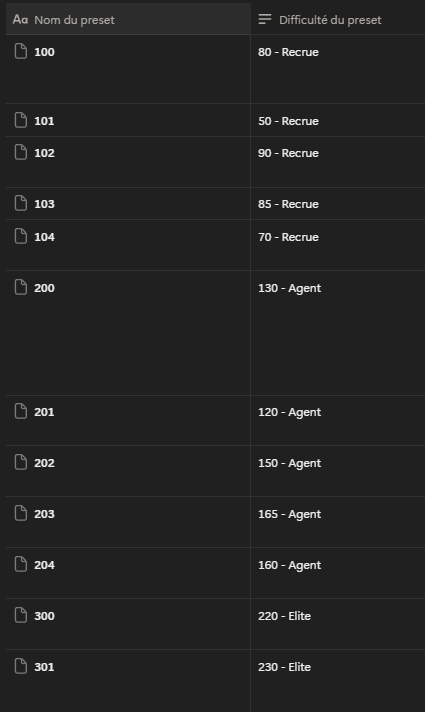
Each preset is individually evaluated and assigned to a difficulty tier — Recruit, Agent or Elite — providing a consistent foundation for balancing modules and scenarios.
A dynamic scoring model combines preset values, scenario difficulty, time bonuses and victory conditions to calculate the total score available for each scenario.
04 — Scenario Design
As part of the design team, I worked on the scenario framework that transforms modules and presets into complete playable missions.
-
Scenario Structure — Each scenario defines the modules and presets used, their progression, overall difficulty, time constraints and win conditions.
-
Gameplay Formats — Developed multiple formats to create different objectives and pacing. For example, SPEED challenges players to complete as many modules as possible within the time limit, while RELAY maintains a constant number of active modules that are progressively replaced.
-
Replayability — Different formats and module combinations allow the same physical content to create distinct missions and player experiences.
-
Narrative Context — Each scenario takes place in a different city, following Vincent Lenoir, Escape Time's recurring antagonist, as he deploys temporal bombs capable of altering the timeline.
05 — Playtesting & UX Research
I designed a complete playtesting methodology for the upcoming beta-testing phase, focused on player comprehension, communication, autonomy and overall experience.
-
Test Protocol — Structured playtests around two 30-minute sessions, with role rotations and an intermediate debrief to compare player behaviour and autonomy between sessions.
-
Observation — Created a structured observation grid to track puzzle identification and resolution, communication, information retrieval, pacing and player difficulties.
-
Player Feedback — Designed questionnaires and debriefs to collect quantitative and qualitative feedback on workload, understanding and overall enjoyment.
-
Design Iteration — Built the methodology to turn observations and player feedback into actionable insights for future design iterations.